Introduction to Philosophy

Introduction to Philosophy

#1 in shows
2026ShowDocumentaryTalk

In Introduction to Philosophy, a nine-hour course, Dr. Bonevac guides us through the major traditions of Western philosophy in eight engaging lectures on ethics, metaphysics, and…

Documentary Talk

Episodes

Pick a season and jump in

  1. 1On Virtue16 Jan 2026 · 61 minIn our introductory lecture, Dr. Bonevac explores the foundations of ethics through virtue theory, drawing on Confucius, Socrates, Plato, and Aristotle to examine what it means to live a good life and cultivate good character. We address three central questions—what kind of person to be, what to do, and how to decide—while discussing virtue as a mean between extremes, the unity of virtues, weakness of will, and the role of habit in developing virtue. The lecture concludes by considering how virtues may instead be complex combinations of simpler traits rather than strict means between extremes.
  2. 2On Deontology16 Jan 2026 · 75 minIn lecture two, we turn to deontological ethics, which emphasizes moral principles and rules for action rather than character traits. We consider a range of approaches—from Abelard’s focus on intentions and Aquinas’s natural law grounded in human flourishing, to ethical intuitionism with its plural moral principles, and Haidt’s five-dimensional moral foundations theory. The lecture builds to Kant’s landmark categorical imperative, challenging us to act only on maxims we could will as universal laws and to treat humanity always as an end, never merely as a means.
  3. 3On Consequentialism16 Jan 2026 · 66 minIn lecture three, we explore consequentialist ethics, focusing on utilitarianism as developed by Jeremy Bentham and John Stuart Mill. We examine how actions are judged by their outcomes rather than intentions or character, considering key concepts like the principle of utility, the felicific calculus, interpersonal comparisons, and Mill’s distinction between higher and lower pleasures. Dr. Bonevac also addresses practical challenges and objections—such as conflicts with rights and calculation difficulties—while highlighting utilitarianism’s systematic, consequence-based approach to resolving moral dilemmas.
  4. 4On Realism16 Jan 2026 · 65 minIn lecture four, we learn about realism in Western philosophy through the contrasting views of Plato and Aristotle. We examine Plato’s theory of Forms, where abstract universals like justice or triangularity are the true realities and physical objects are mere shadows, and contrast this with Aristotle’s view that individual substances, like particular humans or horses, constitute reality. The lecture concludes with Aristotle’s analysis of substance, including essential and accidental properties, highlighting how these two approaches offer radically different ways of understanding reality.
  5. 5On Skepticism16 Jan 2026 · 63 minIn lecture five, we encounter the philosophical tradition of skepticism, examining arguments that challenge our ability to know anything or have reasonable beliefs, from ancient Greek and Chinese philosophers to modern thinkers. We analyze five main skeptical arguments—illusion, comparison, variability, the problem of the criterion, and logical paradoxes about truth and knowledge. Our discussion concludes by considering the skeptical recommendation to suspend judgment for peace of mind, while noting the fascinating self-referential problem that skeptics cannot assert even their own conclusions without contradicting their position.
  6. 6On Rationalism16 Jan 2026 · 60 minIn lecture six, we investigate the rationalist tradition, tracing its roots from Plato to modern thinkers like Descartes and Leibniz. We focus on how rationalists respond to skepticism, arguing that knowledge can be gained independently of experience through innate ideas and a priori truths. We examine Descartes’ “cogito ergo sum” and mind-body dualism, as well as Leibniz’s analytic and synthetic distinctions and his defense of synthetic a priori knowledge. Our discussion concludes by highlighting the fundamental disagreement between rationalists and empiricists about whether all knowledge comes from experience or whether the mind contributes its own innate structures to organize and understand reality.
  7. 7On Empiricism16 Jan 2026 · 67 minIn lecture seven, we study empiricism through John Locke and David Hume, who follow Aristotle in arguing that all knowledge comes from experience rather than innate ideas. We trace how they break complex ideas into simple impressions, yet reach different conclusions about causation, substance, and identity. The lecture concludes with Hume’s radical skepticism, demonstrating how many core concepts—including causation, the self, and morality—may be mere psychological projections rather than features of objective reality.
  8. 8On Idealism16 Jan 2026 · 75 minIn lecture eight, Dr. Bonevac delves into idealism, the philosophical view that everything is mind-dependent, contrasting it with realism which holds that some things exist independently of the mind. We explore how Kant's transcendental idealism distinguishes between phenomena and noumena, examining how this perspective influenced later thinkers like Hegel, who rejected the notion of unknowable things-in-themselves. The lecture concludes by considering pragmatism's response to idealism, Nietzsche's radical relativism, and Russell's realist objection that idealism cannot explain why different minds share similar experiences of the world.

Cast

Dr. Daniel Bonevac

Dr. Daniel Bonevac

Host
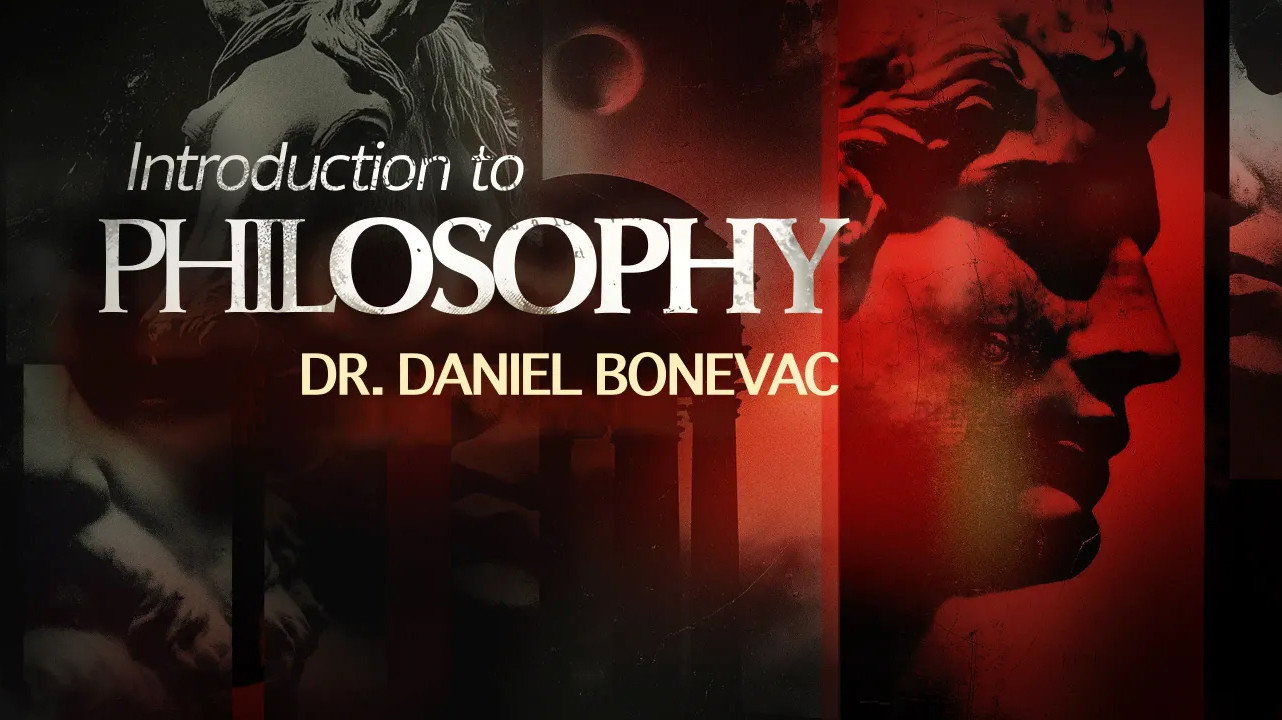
Watch Introduction to Philosophy online (2026 series)

Introduction to Philosophy began in 2026 and has 1 season with 8 episodes, and sits in Documentary, Talk. The main cast includes Dr. Daniel Bonevac.

Every season has its own page with the full episode list, so you can jump straight to the episode you want instead of scrolling one long page. Playback is free and needs no account; the stream comes from a third-party embed provider.

What Introduction to Philosophy is about

In Introduction to Philosophy, a nine-hour course, Dr. Bonevac guides us through the major traditions of Western philosophy in eight engaging lectures on ethics, metaphysics, and epistemology. We explore three key ethical frameworks—virtue ethics, deontology, and consequentialism—before tackling fundamental questions about reality, from realism to idealism. The course then examines theories of knowledge, weighing skepticism’s doubt, rationalism’s innate ideas, and empiricism’s reliance on experience. Finally, we consider how these philosophical traditions continue to shape debates about morality, reality, and human understanding today.

Introduction to Philosophy seasons and episodes

The series has 1 season and 8 episodes in total. Pick a season to see its episode titles, air dates and synopses:

Season 1 opens with On Virtue, followed by On Deontology.

Introduction to Philosophy cast and characters

Dr. Daniel Bonevac Host

Series like Introduction to Philosophy

These are the shows most often watched after Introduction to Philosophy:

Introduction to Philosophy FAQ

How many seasons of Introduction to Philosophy are there?

1 season, with 8 episodes in total. Season 1 is listed first on this page; every season has its own page with the full episode list.

Where can I watch Introduction to Philosophy online?

On this page. Press Play to open the full-screen player at season 1, episode 1. The player's season and episode selectors let you move through the show without leaving full-screen.

When did Introduction to Philosophy first air?

The first episode aired on 16 January 2026. The most recent episode aired on 16 January 2026. The series is currently marked as “Ended”.

What genre is Introduction to Philosophy?

Introduction to Philosophy is listed as Documentary, Talk. You can browse more in Documentary, Talk.

Is Introduction to Philosophy free to watch?

Browsing and playback on MoviesHD are free and need no account. MoviesHD does not host the episodes; the stream comes from a third-party provider, so availability can differ by region.

Keep browsing MoviesHD

All shows · Movies · Anime · FAQ · Disclaimer

MoviesHD does not host, upload, or store any files. Titles shown here are indexed automatically from public sources and third-party services. The media stays on those platforms — we only provide links. This product uses the TMDB API but is not endorsed or certified by TMDB.

© 2026 MoviesHD · v1.1.0